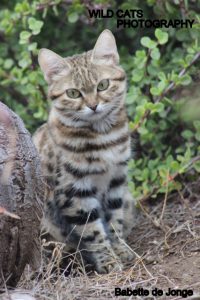
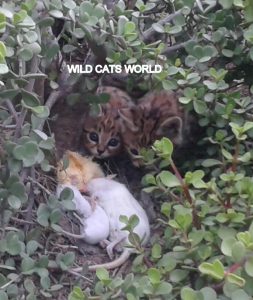
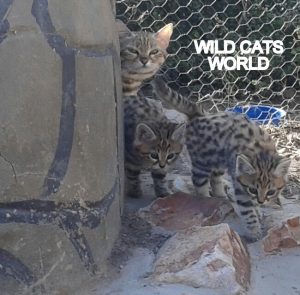
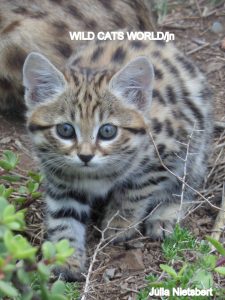
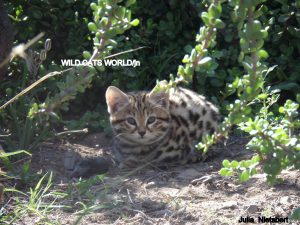
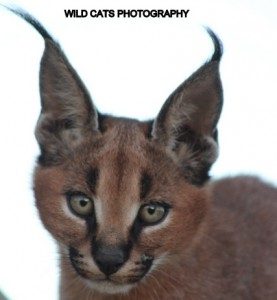
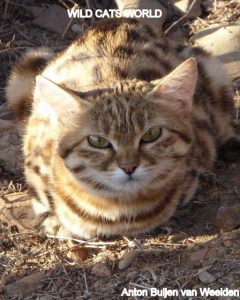
 On Monday 31st of October we could finally welcome two new black-footed cats. Male Spotty and female Lilly. Not much info was given about the cats, as always they suddenly appear and farmers look for a good place for them to stay. While we are almost sure Spotty has been born in the wild, Lilly has a more gentle nature and the latest info we received from the farmers we got them from is that she is a captive born, and a handraised one. She is far less showing the usual “hiss and spit” behaviour compared to the other black footed cats we have and had in our project, so that could be the explanation. Also we were given a picture of a black-footed cat kitten that appears to be Lilly. Judging on these facts she is 1,5 years old now, so pretty young.
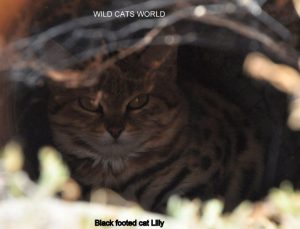 After arrival a week of big worries started for our caretakers team, as both cats didn’t seem to eat. We were told they loved pigeons, but also pigeons they weren’t very keen on the first few days. All the way from Holland, owner/CEO Babette de Jonge, tried to think of ways to make them eat, and the team in the end succeeded to make them eat mice and rats. Game meat, fluffies (one day chicks) and chicken, what most black-footed cats in our project loved, they didn’t want, but when Lilly got her first mice…..she started eating, and eating well. We were very afraid the days of not eating would do them harm, but in the end all turned out in a positive way.
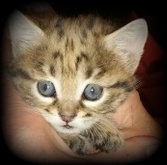 Lilly has to share her Spotty now with neighbour female Diva, and we very much hope both females will soon give birth to some kittens and that they will be raised successfully, as this is very important for the Black-footed Cats Conservation Project.
January 2017
Our black-footed cat ambassadors, females Diva & Lilly and male Spotty, are doing fine. It is great to see them so active and enjoying each other’s company. Of course our hope and aim is for our females to be able to raise some successful litters of kittens, but it is up to Spotty to help us with that.
Note: The black-footed cat, also called small-spotted cat (Felis nigripes), is the smallest African cat and endemic to the southwestern arid zone of the southern African subregion. It is listed as Vulnerable on the IUCN Red List since 2002, as the population is suspected to decline due to bushmeat poaching, persecution, traffic accidents and predation by domestic animals.
At Wild Cats World the black-footed cats conservation project is a very essential one. In every possible way we hope and try to contribute to this incredible but sadly very endangered species!