Much of the reproductive biology of the pampas cat is unknown. Gestation is 80 – 85 days, and litters are said to contain one to three kittens. In captivity, the breeding period appears to be restricted to the months between April and July. They have lived over 16 years in captivity. Unlike some of the other small felids they are reputedly aggressive and not responsive to taming.
Pampas cats are widely distributed and tolerant of altered habitat. International trade in their pelts ceased in 1987. Because of the large range of these cats, their status varies from endangered in Peru, rare in Paraguay and status unknown in Brazil. Much of the pampas of Argentina has been turned into agricultural land and thus their habitat and prey species in this area have been much reduced. Hunting is regulated in Peru, but Brazil and Ecuador have no legal protection for these cats. Hunting is prohibited in Argentina, Bolivia, Chile and Paraguay. Their population status is essentially unknown, and CITES has placed them on Appendix II. Much more research must be done before a clear picture of their status can be formed.
These cats are thought to be mainly terrestrial but will climb trees if pursued. They are thought to hunt small, nocturnal mammals, ground nesting birds such as penguins and their eggs, lizards and large insects. Goat ranchers have reported this little cat kills adult goats, and they are known to raid domestic chicken houses.
Much of the reproductive biology of the pampas cat is unknown. Gestation is 80 – 85 days, and litters are said to contain one to three kittens. In captivity, the breeding period appears to be restricted to the months between April and July. They have lived over 16 years in captivity. Unlike some of the other small felids they are reputedly aggressive and not responsive to taming.
Pampas cats are yet another small felid species that have never been studied in the wild. This lack of knowledge makes it very difficult to develop an effective management plan to protect them. They occur through a wide range of habitats, and the variable colours of their pelage reflect these changes. Three subspecies with distinctive coat patterns and isolated ranges have been proposed as full species, and genetic studies are underway to determine this differentiation.
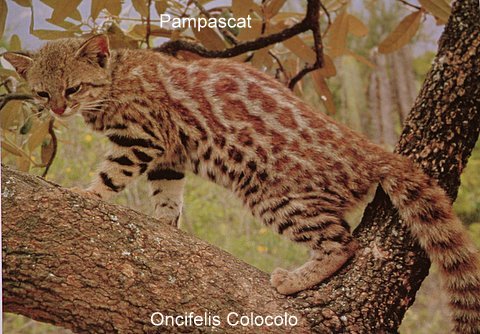
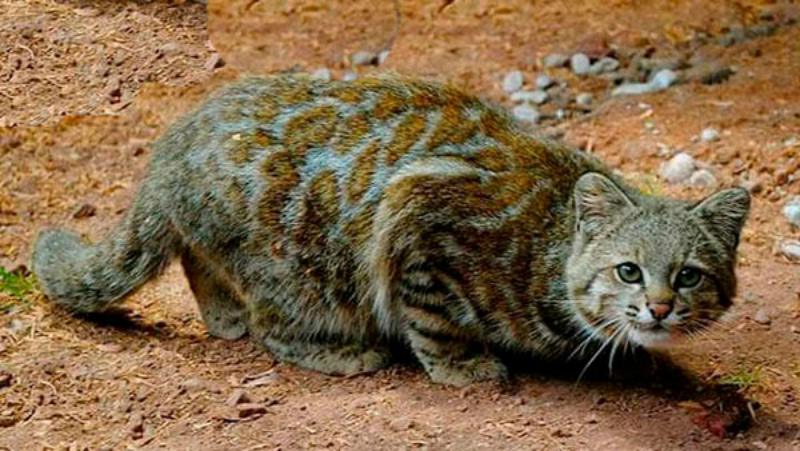
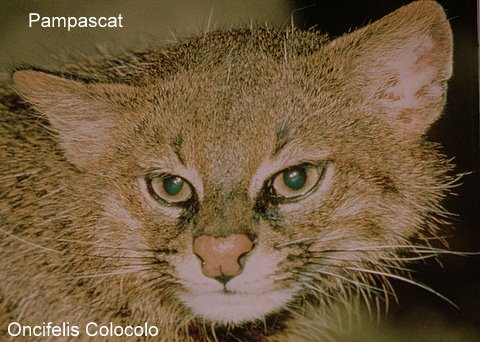
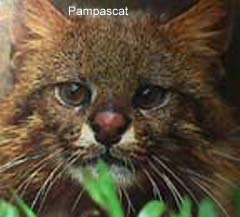
Pampas cats look like heavy set domestic cats, and the fur can vary from thick and soft in colder areas to thin and straw-like in warmer climates. The colour can vary from yellowish-white and greyish-yellow to brown, grey brown, silvery grey and light grey. Underparts are whitish or cream, and marked with brown or black spots. There can be red grey spots or streaks on the pelage, or the coat can be almost unmarked except for brown bands on the legs and tail. There are long, mane-like guard hairs on the back up to seven cm long, that they erect when frightened or nervous. Their head is broad with a short muzzle, and relatively large, amber eyes. The ears are somewhat pointed, and are grey black on the backs with a silvery white central spot. The legs are short and stout, marked with brown or black bars and spots. Their tail is fairly short and bushy, sometimes marked with indistinct rings.
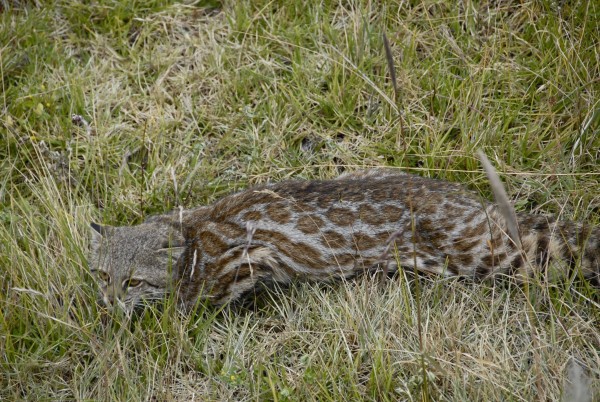
The pampas cat is a small wild cat native to South America, It is listed as Near Threatened on the IUCN Red List as habitat conversion and destruction may cause the population to decline in the future. It is also known as Pantanal cat and colocolo in parts of its range.